Your tax class is responsible for the amount of taxes your employer pays for you. However, it is in your best interest that your tax class is well chosen. If you're not sure - consult us. This will help you avoid one of two dangerous situations - overpaying or worse - underpaying your taxes.
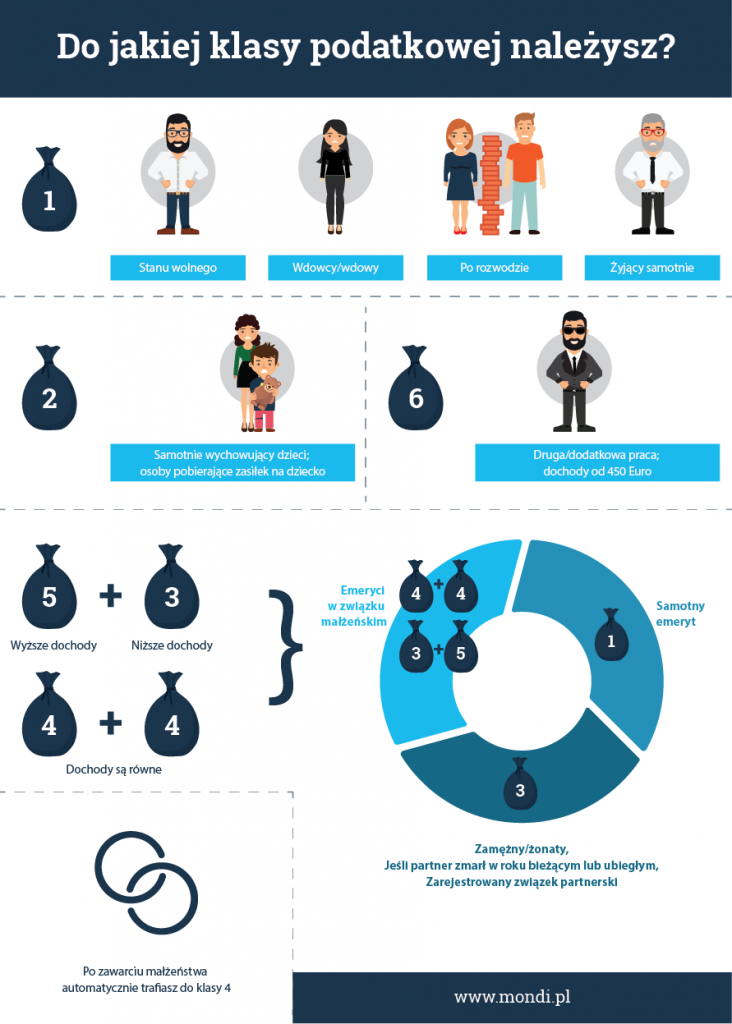
Class 1 – this is where unmarried people are classified – single, married, divorced and widowed. Exceptions are those who fall into Classes II and III.
Class 2 – single persons. This tax class is assigned to unmarried persons and to divorced and widowed persons with at least 1 minor child registered with them. This class includes persons who receive child benefit, guardian’s allowance or Kindergeld. Widowed persons can only belong here if they have not previously been in class III.
Class 3 – these are married persons if the partner is unemployed or not in tax class 5, married persons if the spouse is in a European Community country, and widowed persons during the calendar year.
Class 4 – this tax class is assigned to married persons living together if one spouse is in Class IV.
Class 5 – people whose spouse is in tax class 3 can be accounted for in this tax class.
Class 6 – this class includes people who are employed by more than one employer at one time. Working for two employers at one time qualifies one for this class. This tax class is also granted when there is a discrepancy between the data in the tax authorities and when there is no registration in a particular authority.

The highest advance income tax withholding is for people who are assigned to the 6th tax class, which is associated with the lowest net pay.
You only need to be employed by two employers at the same time to be classified in this class. However, you can take care to change your tax class, especially if you are resident in Germany and have been issued with a German tax identification number (Identifikationsnummer).
Your tax bracket is not only influenced by your income from Germany. In analyzing your situation we will have to show you income from other countries as well.
Remember that your tax class affiliation may be in effect for the calendar year – you will also need to repeat the tax class change procedure the following year.
A sudden increase in one spouse’s income, or the opposite situation – a marriage breakdown – can cause your tax class to change. To avoid a later surcharge on your annual tax return – remember to check your tax class when life brings major changes.
Infographic from Mondi website